FAQ
How do I activate and use the Named EBIS End User License? |
|---|
Use of the Content Web Service requires an EBIS End User license. Users logging in via CWS must have previously been assigned to the Named EBIS User license. |
Possible error message: The maximum number of existing 'EBIS_END_USER' licenses is '0'. |
Do all user accounts from the leading application have to be stored in easy archive? |
|---|
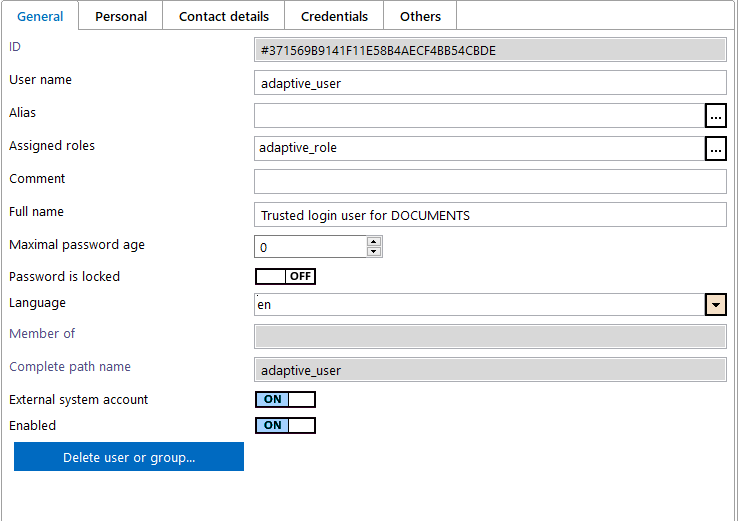
This is not necessary. A technical user can be logged in via the CWS. Prerequisite: The "External system account" property must be active in the technical user account (here an example).
If a document is to be stored via the CWS and the "real" user name is to be used, two additional parameters must be specified in the header of the REST call. x-login-externaluser: j.doex-login-externaluser-fullname: Doe, JohnThis information is written to the relevant archive system fields during archiving. Please note that umlauts in names may not always be transferred correctly to the CWS via the application. The previously |
Login via 'Trusted User' |
|---|
CWS supports the "trusted user" concept of EBIS. x-credential-login-runonbehalfof: <archive user>an be used to specify the archive user in whose name the called archive operation is to be performed. 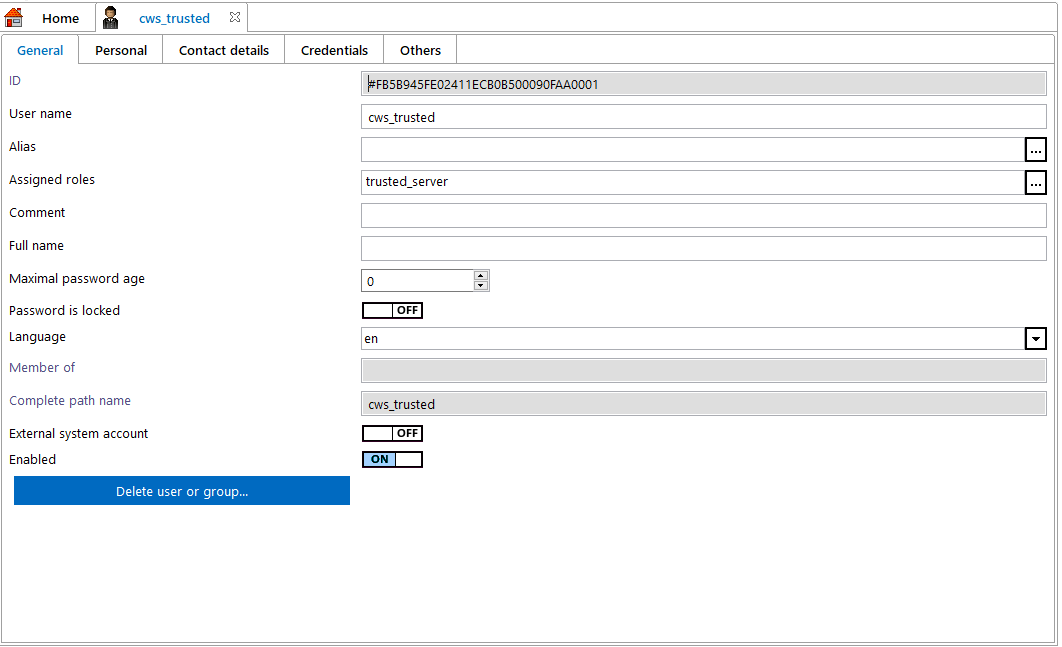 The previously |
How can I retrieve localized content? |
|---|
By default, each request to the Content Web Service interface is executed in the English context. Accept-Language : de x-localized-values : true |
How do I get the full reference to a document, pool, or store? |
|---|
By default, the shorter resource reference is output. x-use-shortreferences: falseThe previously |
How to get a localized hitlist? |
|---|
Sending a search via the Content Web Service interface the response will be not localized. To get the localized display names for all columns the resultInfo GET request has to be made. |
How to get a localized document? |
|---|
After a GET request on /api/content/docs/<docId> the content is not localized. It is neccessary to follow the schema link to get all attribute names with its localized displaynames. |
How can I determine the interface version? |
|---|
Case: /api/content See also GET / in the API reference. |
How can I get information about the user? |
|---|
Case: /api/content/user See also GET /user in the API reference. |
How can I query a specific document? |
|---|
Case: /api/content/docs/{DokumentReferenz} See also GET /docs in the API reference. |
How can I query a specific attachment? |
|---|
Case: /api/content/docs/{DokumentReferenz}/attachment/{id} See also GET /docs in the API reference. |
How can I conduct a full text search? |
|---|
Case: /api/content/search See Request-Body in the API reference. |
How can I perform a field search? |
|---|
Case: /api/content/search See Request-Body in the API reference. |
How can I perform an AND search? |
|---|
Case: /api/content/search Search expressions are generally always linked with AND unless you specify other operators (see below). See Request-Body in the API reference. |
How can I perform an OR search? |
|---|
Case: /api/content/search See Request-Body in the API reference. |
How can I perform a NOT search? |
|---|
Case: /api/content/search See Request-Body in the API reference. |
Which date formats are valid? |
|---|
Dates to be used must match the following formats:
Example:
|
How can I use pools instead of stores in queries? |
|---|
Case: /api/content/stores The store resource supports an optional query parameter: pool=true. If this is set, a query of the stores will return a list of the pools with their respective unique store ID. This ID (storeId) can be used as store name in subsequent queries. See GET /stores in the API reference. |
Error messages
Error message | Error description |
|---|---|
Page number /arg1 is outside the allowed boundaries. The number of pages is /arg2. | Example: Page number 31 is outside the allowed boundaries. The number of pages is 29. Hit list page 31 was queried using a CWS request via the path parameter path. |
Cannot connect to r-osgi://localhost:9278 | If it is possible to get a response at /api/content but any other entity replies with that error message you have to add a header parameter to your request. X-ebissystem : <name of your logical system> |